
Shirt Packaging Accessories 101: The Basic Function of Every Component in a Packed Shirt
Short answer: shirt packaging accessories are the small, mostly invisible components that hold a folded shirt in shape between the packing table and the customer's hands. Each one has a single job. The collar band, collar stay and collar support insert hold the collar upright. The paper or plastic butterfly stops the collar fold from creasing. The metal pin or the plastic clip keeps the fold closed. The cardboard, belly band and size strip keep the bundle flat and identifiable. The tissue paper, poly bag, gift box, hang tag and washing label carry protection, presentation and information.
None of these items adds fabric value. All of them decide how the fabric is judged. This explainer walks through every basic component in a packed shirt, states what it actually does, and shows how those functions connect to the way distributors and brand owners buy these accessories over the long term.
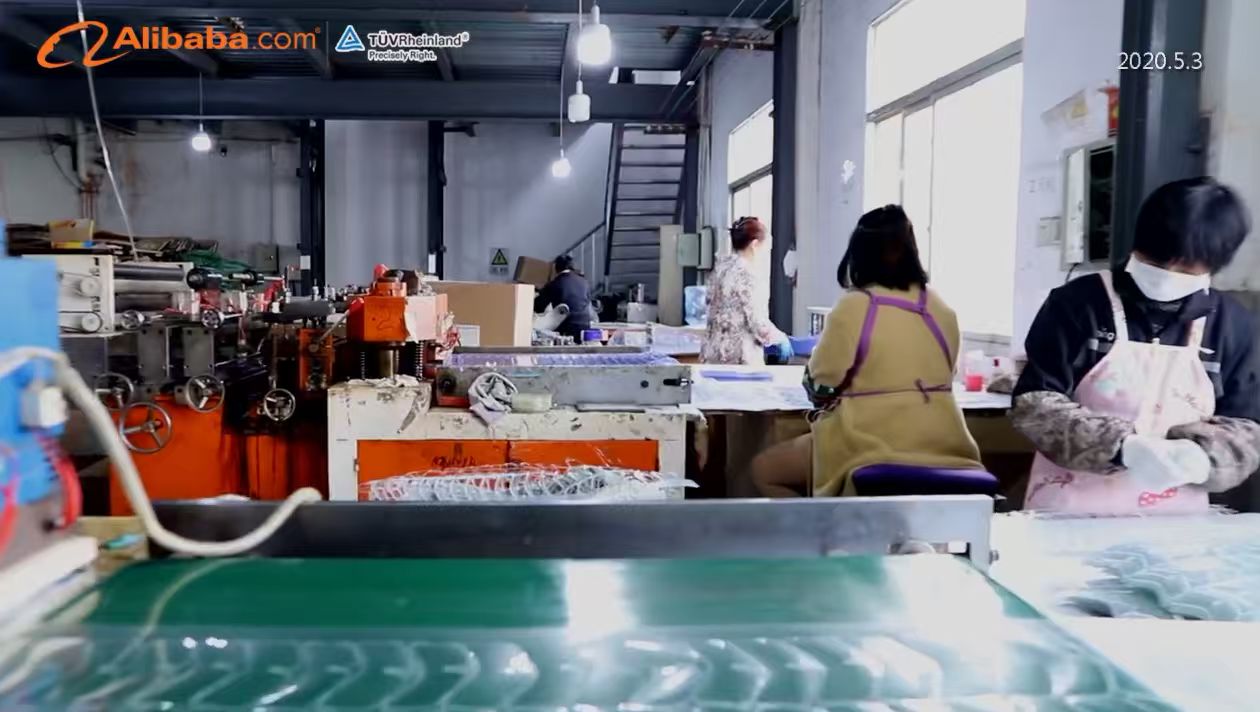
Production site of Wuxi Mingyu Garment Accessories Factory, a shirt packaging accessories manufacturer based in Wuxi, Jiangsu, China.
The problem these components solve
A pressed shirt leaves the iron with a clean collar, sharp placket and straight fold. Without packaging accessories, that condition lasts roughly as long as it takes to slide the shirt into a carton. Collar points bend inward, the collar fold takes a crease that cannot be pressed out at the retail counter, the folded body opens, and the shirt arrives looking handled rather than new.
The failure is not cosmetic only. A collapsed collar changes how a buyer reads the whole garment: fabric weight, stitching quality and fit all become secondary to the impression that the item was poorly finished. Because the collar is the first surface a customer touches and the first surface a merchandiser inspects, packaging components that protect the collar carry a disproportionate share of the perceived quality.
There is a second, quieter problem: identification. A packed shirt without a size strip, hang tag and washing label cannot be sorted, cannot be priced and cannot be sold. Packaging accessories therefore split into four functional families, and every packed shirt needs at least one component from each:
- Structure — collar band, collar stay, collar support insert, butterfly, cardboard.
- Closure — metal pin, plastic clip, belly band.
- Protection — tissue paper, poly bag, gift box.
- Information — hang tag, size strip, washing label.
Buyers who understand this split stop purchasing accessories item by item and start purchasing them as a kit, which is also the point at which long-term supply relationships become practical.
Industry background: why a low-cost component gets so much attention
Garment packaging sits inside a large and still-expanding budget line. Dataintelo values the global garment packaging market at USD 18.6 billion in 2025, with a projected rise to USD 31.4 billion by 2034. Asia Pacific accounted for 41.5% of revenue in 2025, which matches where most shirt assembly and shirt packing actually happen.
One component family inside the shirt has its own measurable market. The Business Research Company reports that garment interlining, the structural material behind a shirt collar, reached USD 3.65 billion in 2025. Interlining gives the collar its body; packaging accessories give that body a shape to hold. The two are functionally linked, which is why collar-related accessories dominate technical discussion in this category.
What the market numbers do not show is the buying pattern. Shirt packaging accessories are consumed continuously, in the same rhythm as shirt production, and they are low-value per unit but high-risk per failure. A carton of collar bands costs a fraction of the shirts it protects, yet a missing collar band can turn an entire shipment into second-quality stock. That asymmetry is why distributors treat these items as a recurring supply relationship rather than a one-off purchase.

Shirt packaging accessories are produced on automated punching and die-cutting equipment to keep component dimensions consistent between orders.
Component by component: what each accessory actually does
Every item below appears in a normal packed shirt. The description states the function only; the material options listed are the ones commonly produced in this category.
1. Collar band (plastic collar band, PVC or PET)
The collar band is the component that wraps around the folded collar and physically holds it closed. It is the first structural element in the pack and the one that carries the collar through carton compression, stacking and transport. Bands are produced in PVC and PET, and the material choice affects how much deformation resistance the band delivers and how it behaves under load.
Function summary: keeps the collar folded at a controlled radius, prevents the collar from opening inside the carton, and presents a printable surface for brand marking.
2. Collar stay (metal collar stay, plastic or PVC collar stay)
The collar stay is a thin blade inserted into the stay pocket on the underside of the collar to keep the collar points straight and symmetrical. Metal stays provide stiffness; plastic and PVC stays offer a lighter, non-metallic option. The stay is normally removable, so the customer takes it out before wearing the shirt.
Function summary: holds collar point geometry, prevents curling during transit, and restores a crisp line at the point of sale.
3. Collar support insert and collar bone
The collar support insert, also called a collar bone or collar insert, is a rigid shaped piece placed inside the collar opening. Where the stay works at the points, the support insert works on the whole collar cavity, holding the collar's three-dimensional form so the collar does not flatten under the weight of stacked cartons.
Function summary: maintains collar volume, protects the collar from crush damage, and keeps the collar standing when the shirt is displayed.
4. Collar butterfly (paper butterfly, plastic butterfly, bubble)
The butterfly is the small butterfly-shaped piece that sits under the collar points on the fold line. It distributes pressure across the fold instead of concentrating it at the tips, which is what prevents a hard crease from forming across the collar. Paper butterflies suit standard retail packing; plastic and bubble versions add protection where the pack will be handled repeatedly or shipped long distance.
Function summary: spreads fold pressure, prevents collar creasing, and protects the collar tips from abrasion.
5. Metal pin and shirt clip (PS plastic or metal)
Pins and clips close the folded shirt. A metal pin passes through the fabric and holds the fold with high retention; a PS plastic clip or a metal clip grips the fold without piercing it. The choice is a trade-off between holding strength and fabric penetration, and it should follow the fabric weight and the folding style rather than habit.
Function summary: holds the folded body closed, keeps the placket and collar aligned, and prevents the shirt from opening inside the poly bag.
6. Shirt packaging cardboard
The cardboard backing board is the flat structural base of the pack. It gives the folded shirt a straight spine, keeps the fold square, and provides a rigid plane so the shirt does not sag inside the bag or box.
Function summary: maintains a flat, square fold, supports the shirt shape in the bag, and provides a surface for printed brand information.
7. Belly band and garment size strip
The belly band wraps around the folded shirt and holds the whole bundle together without adhesive. The size strip, normally combined with the band or applied alongside it, identifies the size so the pack can be sorted and shelved without opening it.
Function summary: keeps the folded bundle closed, prevents slipping between layers, and carries size and product identification at retail.
8. Tissue paper and moisture-proof paper
Tissue paper separates the shirt from the cardboard and the bag, absorbs small amounts of moisture, and adds a clean unwrapping layer. Moisture-proof paper is used where humidity during shipping is the bigger risk.
Function summary: protects the fabric surface from abrasion, buffers humidity, and improves the unboxing sequence.
9. Poly bag and gift box
The PE clear bag or plastic packaging bag is the primary barrier against dust and handling. The gift box replaces or supplements the bag for premium and gifting channels, adding rigidity on top of presentation.
Function summary: seals the pack against contamination, protects against transit abrasion, and sets the presentation level of the product.
10. Apparel tag and washing label
The hang tag carries brand, price and product information; the washing label carries fiber content, care instructions and origin. Both are compliance items, not decoration, and both must be present before a pack can legally reach retail in most markets.
Function summary: delivers mandatory product information, supports retail pricing, and completes the brand presentation.
Step-by-step: a practical packing sequence
The components above only work in the right order. This is the sequence used for a standard folded shirt pack, and it is also the sequence a distributor should use when auditing a supplier's kit completeness.
- Press and cool. The collar must be fully cooled before any component touches it, otherwise the band and butterfly will lock in a soft fold.
- Insert the collar stays. Seat both stays fully into the pockets so the points are symmetrical.
- Place the collar support insert. Fit the insert inside the collar cavity so the collar holds its shape before folding.
- Position the butterfly. Centre it on the fold line under the collar points, not on the collar edge.
- Fold the shirt. Fold to the agreed width, keeping the placket straight and the collar centred.
- Add the cardboard. Slide the backing board behind the fold so the spine is square.
- Close with pin or clip. Match the closure to the fabric: pin for retention, clip where fabric penetration is unacceptable.
- Apply the belly band and size strip. Band tension should hold the bundle without compressing the collar.
- Wrap in tissue, then bag or box. Tissue goes between shirt and outer pack, never between shirt and collar.
- Attach the hang tag and confirm the washing label. Verify the tag, the size strip and the washing label agree before the pack is closed.
This order matters because each step protects the result of the one before it. Packing out of sequence is the most common cause of a collar that looks correct on the table and crushed on arrival.

Export documentation and certification material is part of the accessory supply, not an afterthought.
Use cases: the same components in four different packs
Retail-ready folded shirt. This is the default pack. Collar stay, collar support, butterfly, cardboard, pin or clip, belly band with size strip, tissue paper, poly bag and hang tag. Every component is present, and the collar is the item under most pressure.
Export carton packing for distributors. The same kit, but the collar support insert and butterfly carry more of the load because the shirt will be compressed by other cartons. Where long sea transit is involved, moisture-proof paper replaces standard tissue paper.
Premium gift box programme. The gift box replaces the poly bag, and the butterfly and collar band become presentation surfaces rather than purely functional items. Printing, foiling and logo work are typically specified at this level, which makes mould and print consistency part of the sourcing decision.
Sample and pre-production kits. When a brand approves a new shirt design, the packing kit is approved at the same time. Confirming the collar stay length, band width and butterfly type before bulk production prevents a mismatch between the approved shirt and the approved pack.
Component comparison table
| Component | Primary function | Common material options | What fails without it |
|---|---|---|---|
| Collar band | Holds the folded collar closed | PVC, PET | Collar opens inside the carton |
| Collar stay | Keeps collar points straight and symmetrical | Metal, plastic, PVC | Collar points curl or bend |
| Collar support insert | Maintains collar volume under load | Rigid shaped insert | Collar flattens in stacked cartons |
| Butterfly | Spreads pressure across the collar fold | Paper, plastic, bubble | Hard crease across the collar |
| Metal pin | Closes the fold with high retention | Metal | Fold opens before bagging |
| Clip | Closes the fold without piercing fabric | PS plastic, metal | Loose fold, placket misalignment |
| Cardboard | Gives the pack a flat square spine | Printed cardboard | Shirt sags inside the bag |
| Belly band | Wraps and holds the folded bundle | Paper, plastic film | Layers slip apart |
| Size strip | Identifies size without opening the pack | Paper, adhesive label | Sorting errors at retail |
| Tissue paper | Separates fabric and buffers humidity | Tissue, moisture-proof paper | Surface abrasion, damp marks |
| Poly bag / gift box | Seals the pack against dust and handling | PE clear bag, gift box | Contamination, presentation loss |
| Hang tag and washing label | Carries brand, price and care information | Printed paper, woven or printed label | Product cannot be legally retailed |
Material options shown are the ones commonly produced for these components. Final selection depends on fabric weight, folding style and destination market requirements.
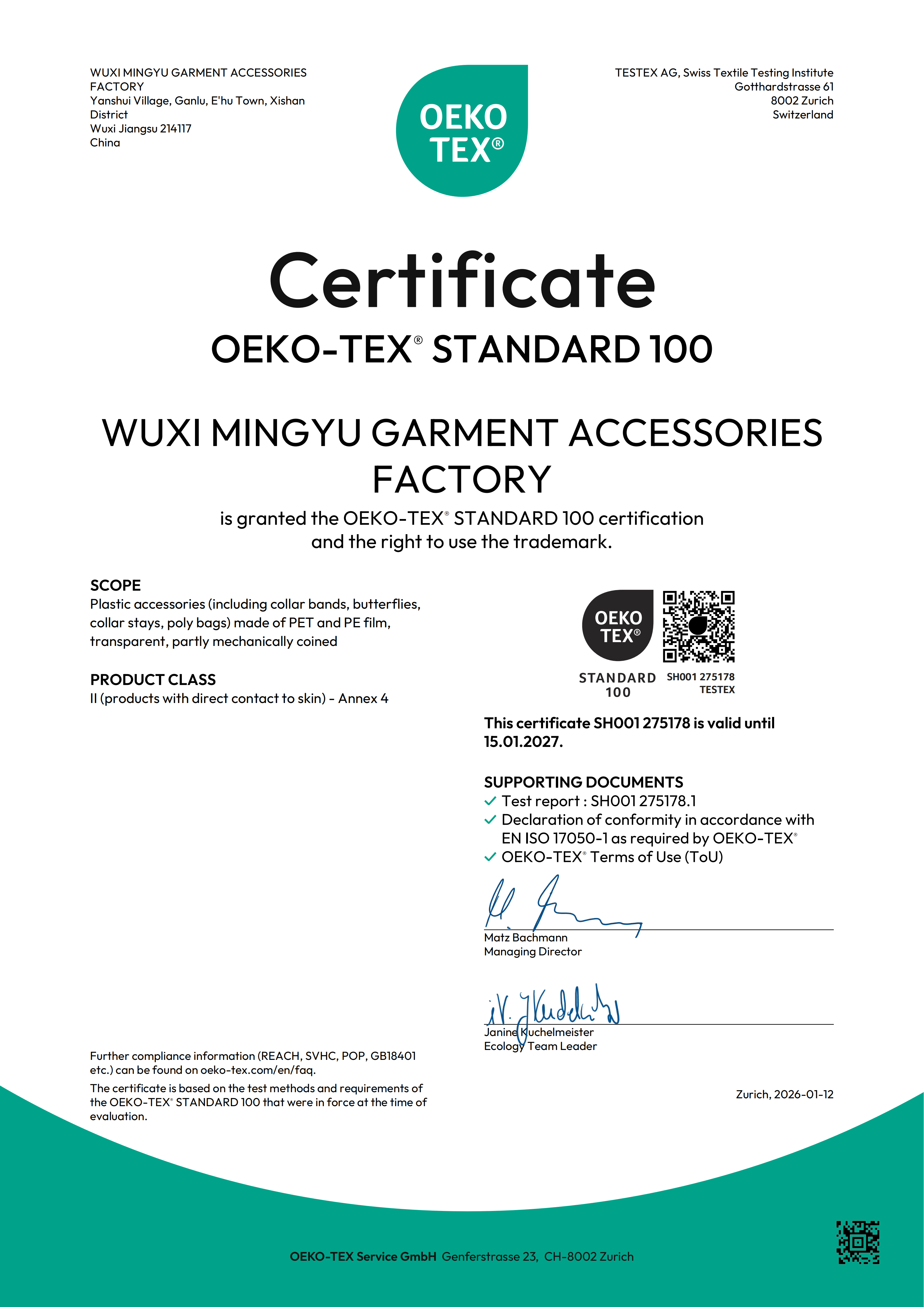
Certification records and in-house quality control support consistent component supply across repeat orders.
From components to a supply relationship
Once a buyer understands what each component does, the purchasing question changes. It is no longer which collar band to buy; it is who can keep the same collar band, the same butterfly and the same printed cardboard arriving at the same specification, order after order, for as long as the shirt programme runs.
That is the operating model behind Wuxi Mingyu Garment Accessories Factory, a garment accessories manufacturer founded in 2004 in E'hu Town, Xishan District, Wuxi, Jiangsu, China. The company produces shirt packing accessories including PVC and PET collar bands, collar stays, collar butterflies, shirt cardboard, moisture-proof paper, plastic clips and plastic packaging bags, and supplies one-stop garment-accessory customized solutions for global clothing brands and garment manufacturers, supporting OEM and ODM orders.
Three structural details matter to a distributor evaluating a long-term partner. First, production: a 2,500 m² facility with automatic punching and automatic cardboard and collar stay die-cutting equipment, an annual output of 90 million sets, and a 3-engineer R&D team for custom size, colour, printing and logo work. Second, quality control: an in-house team running full-range inspections through each production stage to keep product consistency stable. Third, geography: an export ratio of 85% across Europe, North America, South America and Asia, with overseas warehouses, agencies or manufacturing operations in Sri Lanka, Argentina, Bangladesh, Indonesia, Colombia and Kenya, plus a Sri Lanka factory established in 2013 and a Vietnam factory in 2017.
For a distributor, those three details translate into one outcome: the specification approved at the start of a programme is the specification delivered at the end of it. That is the practical meaning of a long-term accessory supply relationship.
Frequently asked questions
Are shirt packaging accessories supplied with export documentation and certificates?
Yes. MingYu provides complete authoritative certificates for export and has direct experience with factory audit inspections. Because the accessories touch the garment, documentation is treated as part of the order rather than a separate request, and buyers should confirm the certificate set required for their destination market at the quotation stage.
Can one supplier deliver a full multi-component shirt packing kit under a single OEM or ODM programme?
Yes. The product range covers collar stays, collar bands, paper butterflies, hang tags, belly bands, tissue paper, gift boxes and PE clear bags in one supply chain, with OEM and ODM customization on size, colour, printing, hot-foiling, logo stamping and mould opening. Buying the kit from one source removes the specification mismatch that occurs when collar bands, butterflies and cardboard come from three different vendors.
What are the commercial terms for a first order?
The published FAQ lists a minimum order quantity of 1,000 sets for customized programmes. Delivery terms are FOB, CIF or EX Works, and payment terms are TT with a 30% deposit and 70% balance before shipment. Large-bulk programmes are supported by an annual output of 90 million sets, so volume is rarely the constraint; specification approval usually is.
How is quality validated before shipment?
Acceptance is based on a pre-shipment test, and the in-house quality-control team carries out full-range inspections throughout each production procedure. For a mixed accessory kit, validation should cover component dimensions, print registration and colour consistency across the full set, not just a single item.
What lead time should a distributor plan for?
Standard lead time is 7 to 20 working days after order confirmation. Regional clients covered by the overseas warehouses and branches in Sri Lanka, Argentina, Bangladesh, Indonesia, Colombia and Kenya can shorten the last-mile portion of that timeline. For a repeat programme, the practical planning rule is to lock the specification once and then reorder against it, rather than re-qualifying the kit each season.
If you are building or renewing a shirt packing programme, the next step is a specification review rather than a price list. Send your current collar band size, stay type, butterfly format and folding style to lili.ma@wxmingyu.com or WhatsApp +86 15052109975, and the team will map them against the available range. The company profile and full product list can be downloaded here: MingYu Garment Accessories company profile (PDF). More detail is available at www.wxmingyu.com.

Overseas warehouses and branches support repeat-order delivery for distributors in Asia, South America and Africa.
Conclusion
Shirt packaging accessories are a small set of components with a narrow, well-defined job: hold the collar, protect the fold, close the pack, protect the fabric, and carry the information the product legally needs. The collar band, collar stay, support insert and butterfly do the structural work. The pin, clip and belly band do the closing work. Tissue paper, the poly bag and the gift box do the protection work. The hang tag, size strip and washing label do the information work.
What separates a good pack from a mediocre one is not the presence of these items but the consistency of their specification. A collar stays crisp when the same stay, the same band tension and the same butterfly are repeated across every production run. That consistency is a supply-chain property, not a product property, and it is the reason this category is bought as a long-term relationship rather than a series of transactions.
Have Questions or Need More Details?
Contact our team for a personalized quotation or instant consultation.
Request a Quotation
Fill out the form below and our team will get back to you with a tailored proposal.
WhatsApp Direct Chat
Prefer to chat in real-time? Message us on WhatsApp for instant assistance & quick answers.
- Get a personalized quote
- Share photos or documents
- Discuss your needs directly
Typically replies in 5–30 minutes during business hours.