
Shirt Packaging Accessories: Regional Compliance Rules for Plastic, Metal, PVC, and Paper
Short answer: a shirt packaging accessory clears a regional compliance review only when three elements line up — the base material of the item, the documented scope of the certificate attached to it, and the construction detail written into the purchase order. A certificate issued for transparent PET and PE film plastic accessories does not automatically extend to a white PVC collar stay, a stainless steel collar stay, a brass pin, or a 400 gsm paper butterfly. Buyers who treat “certified” as a container-level attribute are the ones whose cartons get re-tested at destination.
Why “certified” is not a container-level attribute
Shirt packaging is a high-frequency, low-unit-value category built out of mixed materials. A single carton bound for a European or North American buyer routinely contains PET collar bands, white PVC collar stays, metallic collar stays, PS clips, stainless steel pins, 400 gsm paper butterflies, 500 gsm apparel tags, tissue paper, belly bands and PP poly bags. Each of those lines answers to a different material question, and increasingly each line is asked for its own evidence.
The practical difficulty is that compliance paperwork is usually produced at supplier level, while compliance questions are asked at item level. Three mismatch patterns repeat across buyer audits.
- Material transfer. A certificate covering plastic film accessories is presented as coverage for the whole accessory programme, including metal pins and paper components.
- Line-level borrowing. One document is attached to a purchase order line whose material and construction were never described in that document.
- Construction left blank. The purchase order specifies “collar stay” without thickness, or “clip” without material, so no reviewer can determine which question family applies.
A usable compliance statement for a shirt packaging accessory therefore has four parts, and all four must be present before the statement travels with a shipment: the item identity, the material plus construction detail, the identity and validity window of the supporting document, and the destination market the statement is being asserted against. Remove any one part and the statement becomes an opinion rather than a record.
Why accessory-level documentation now decides shipment readiness
The commercial weight behind this category is easy to underestimate because the parts are small. Dataintelo values the global garment packaging market at USD 18.6 billion in 2025 and projects USD 31.4 billion by 2034. The Business Research Company places the garment interlining market — the structural material that sits inside a shirt collar — at USD 3.65 billion in 2025. Dataintelo also reports that Asia Pacific held a 41.5% revenue share of the garment packaging market in 2025, which means the majority of documentation requests are issued in one region and satisfied in another.
Two structural features of the category drive the compliance pressure. First, accessory spend per shirt is small, so buyers consolidate many lines with one supplier; consolidation is exactly what causes documents to be borrowed across materials. Second, accessories are handled, packed and shipped with the finished garment, so an accessory defect or a documentation gap stops a garment shipment rather than an accessory shipment. The cost of a missing scope statement is therefore measured in finished shirts.
The four material families and their compliance checkpoints
Regional questions cluster by material rather than by product name. A PVC collar stay and a PVC collar support answer the same family of questions; a PVC collar stay and a stainless steel collar stay do not. The sections below follow the four families that dominate a shirt packaging order.
1. Plastic film accessories: PET, PVC and PS behave differently
PET is the material most often documented in this category. The white plastic collar band is specified in White PET at 48.1 × 4 cm × 0.35 mm, and the white PET band family is the item type most frequently named in buyer documentation requests. PVC appears in a different cluster of products: the plastic collar stay is White PVC at 6.35 cm × 1 cm × 0.75 mm, the collar support is Light Blue PVC at 22.7 × 18.5 cm × 0.35 mm, and the light blue fine sand plastic butterfly is PVC at 26 × 10.4 cm × 0.25 mm. PS appears in clip construction, where the clip is specified in PS or metal at 3.3 cm or 3.7 cm × 0.8 cm × 1.2 mm thickness.
The compliance consequence is that PET film documentation and PVC documentation are not interchangeable, and a buyer should never accept a single plastic statement as coverage for a mixed plastic order. When a supplier presents one plastic document, the first review question is which polymer the document actually describes.
2. Metal components: alloy and finish, not “metal”
Metal lines in shirt packaging are the metallic collar stay, the metal pin and the metal clip option. The metallic collar stay is specified in stainless steel across four common sizes — 55.9 × 9 × 0.8 mm, 63.5 × 9 × 0.8 mm, 69.9 × 9 × 0.8 mm and 76.2 × 9 × 0.8 mm — with a common thickness of 0.8 mm and laser-engraved logo as a customization. The metal pin is specified in stainless steel or brass at a common size of 26 × 0.6 mm, with 0.6 mm or 0.65 mm thickness. The metal clip shares the 1.2 mm thickness and 3.3 cm / 3.7 cm length envelope of the PS clip.
Because stainless steel and brass are different alloys, a metal statement that does not name the alloy cannot be relied on. Laser engraving is a marking process and does not change the base alloy, so an engraved logo is not itself a compliance variable — but it is a reason to state the alloy explicitly on the purchase order, since the engraved item is the one most likely to be inspected.
3. Paper and board: mono-material is easier to document than composite
Paper is the simplest family to document when the item is a single fibre stream. The paper butterfly is 400 g single white paper at 15 × 3 cm. Apparel tags use 100% natural wood-pulp paper at 4 × 7 cm, 500 gsm. Shirt packaging cardboard uses 100% natural wood pulp paper at 21 × 35.2 cm, 500 gsm. Tissue paper is 36 × 40 cm at 17 gsm. The paper belly band is 58 × 10 cm at 0.25 mm, and the paper collar band uses specialty tenacity paper at 47.2 × 3.8 cm with a 1 mm profile.
The composite exception is the gift box: paper cardboard wrapped with 120–150 g art paper at 22 × 35 cm and 2–3 mm thickness. A wrapped board is two materials bonded together, so any recyclability or mono-material statement attached to a gift box should be checked against the wrap, not just the board. The same logic applies to the washing label, which is specified as polyester or nylon taffeta — a textile label inside a paper-and-plastic packaging bill of materials, and one that is often left out of packaging documentation entirely.
4. Clips and pins: the mixed-material lines that get missed
Clips and pins are the lines most likely to fall between material families. The clip is offered in PS or metal at 1.2 mm thickness, in X-shape, with customizable logo, at a minimum order quantity of 100,000 pcs. The metal pin is stainless steel or brass at 26 × 0.6 mm, with a minimum order quantity of 10,000 pcs. A clip order therefore contains a material decision, and a pin order contains an alloy decision. Neither can be documented by reference to a film certificate.
What the two MingYu certificates actually cover
Wuxi MingYu Garment Accessories Factory holds two third-party certificates that buyers most often request. Both are useful, and both have defined edges that a buyer should read before attaching them to an order.
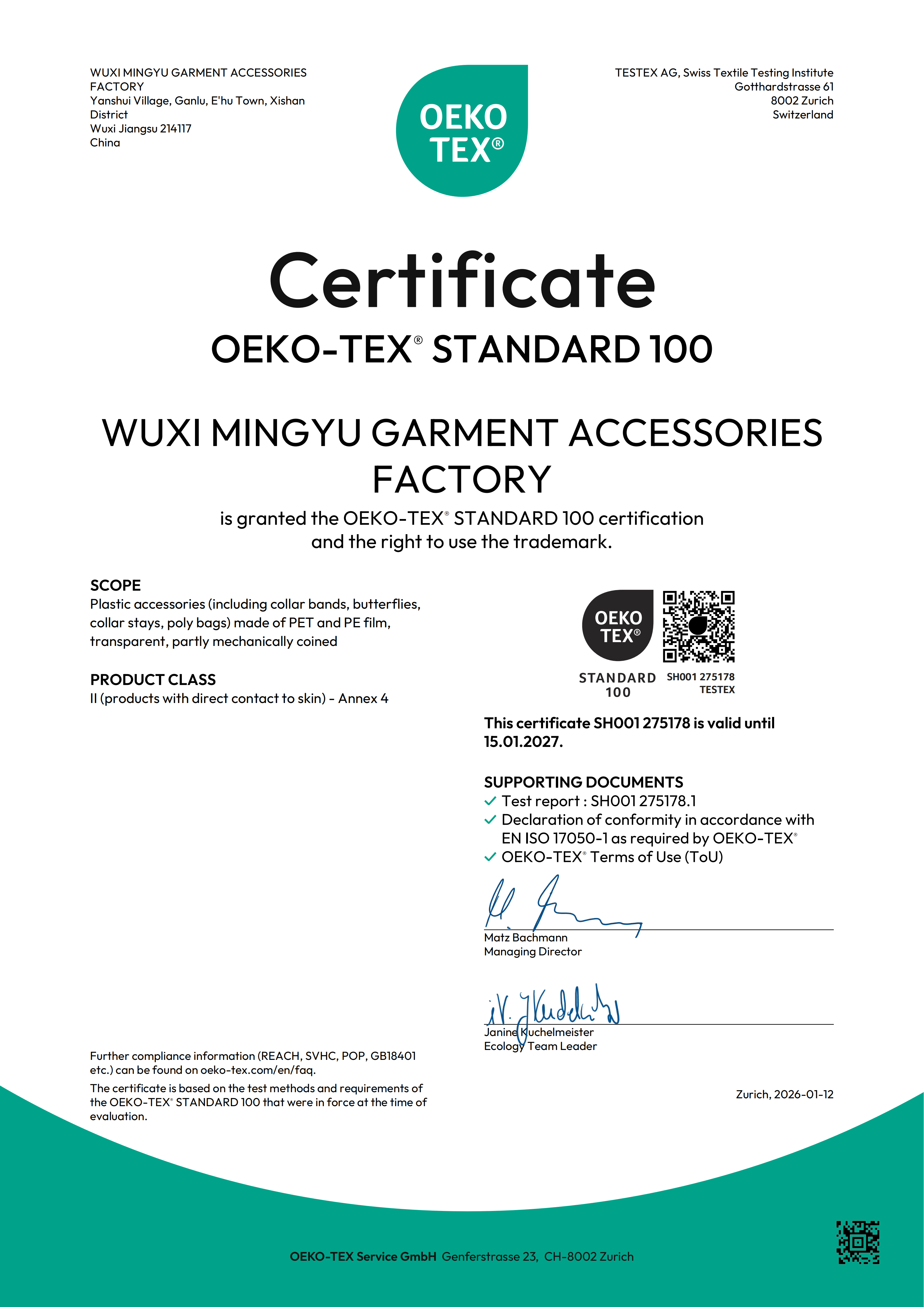
| Document | Issuer and reference | Validity | Scope as issued |
|---|---|---|---|
| OEKO-TEX STANDARD 100 | TESTEX, certificate SH001 275178, standard OEKO‑TEX® STANDARD 100 and EN ISO 17050‑1 | Issued 2026-01-12, valid to 2027-01-15 | Plastic accessories (including collar bands, butterflies, collar stays, poly bags) made of PET and PE film, transparent, partly mechanically coined |
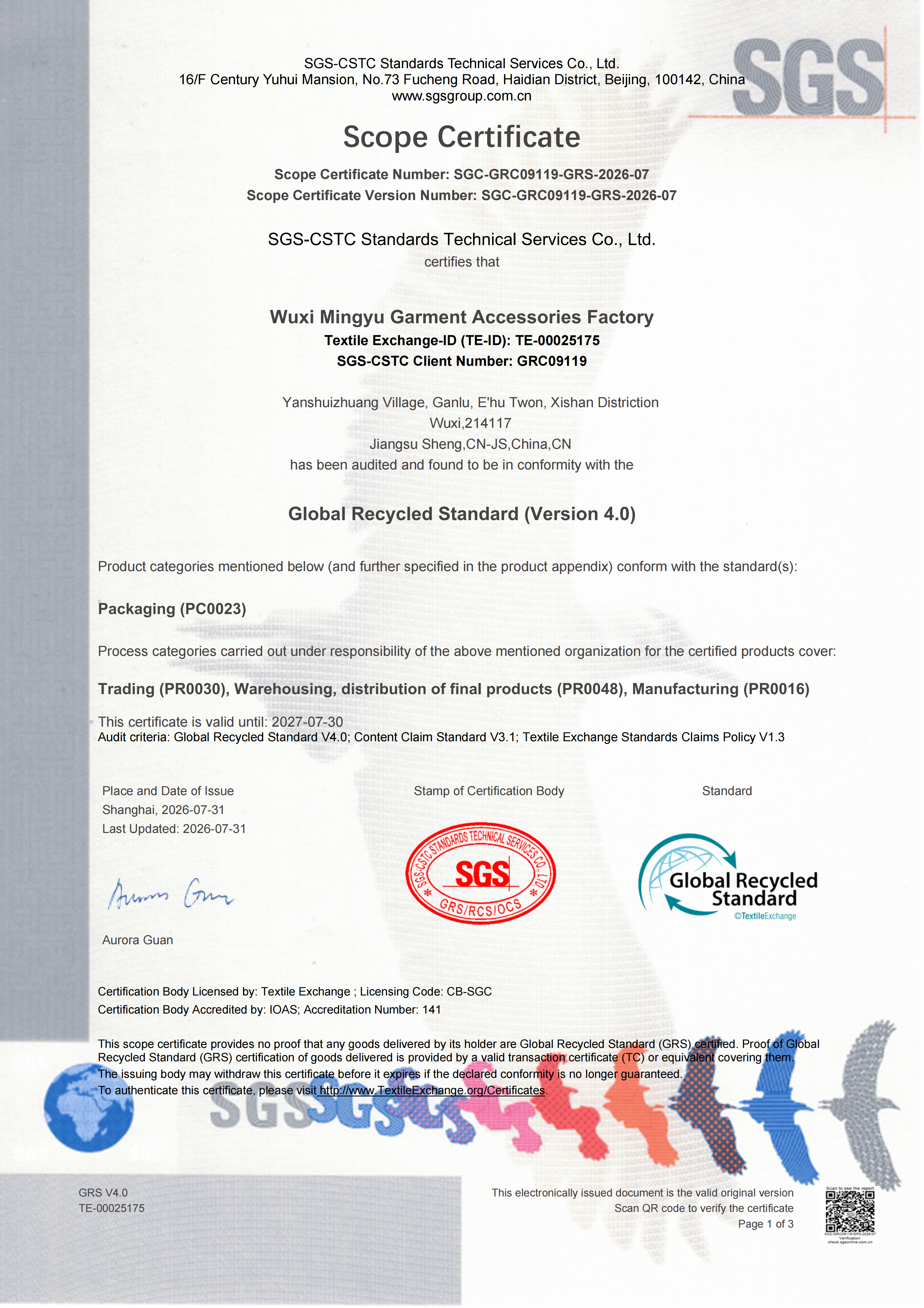
| GRS | SGS, certificate SGC-GRC09119-GRS-2026-07, against Global Recycled Standard V4.0, Content Claim Standard V3.1 and the Textile Exchange Standards Claims Policy V1.3 | Issued 2026-07-31, valid to 2027-07-30 | Trading (PR0030), warehousing and distribution of final products (PR0048), manufacturing (PR0016) |
Read together, the two documents answer different questions. The OEKO-TEX certificate is a material-scope document describing plastic accessories made of PET and PE film, transparent and partly mechanically coined. It is not a metal document and not a paper document. The GRS certificate is a recycled-content chain-of-custody document covering trading, warehousing and distribution, and manufacturing activity — it speaks to how recycled content is tracked through the supply chain, not to chemical safety of a finished part.
Three practical consequences follow, and they are the reason this section exists in a buying guide rather than in a certificate drawer.
- PVC items sit outside the described film scope. The white PVC collar stay at 6.35 cm × 1 cm × 0.75 mm, the light blue PVC collar support and the PVC plastic butterfly are PVC constructions, while the certificate scope describes PET and PE film. Buyers should confirm item-level coverage rather than assume it.
- Metal and paper items are not covered by either document. Metallic collar stays, metal pins, paper butterflies, cardboard, tissue paper, belly bands, apparel tags and gift boxes require their own evidence route.
- Material naming matters at line level. The poly bag line is specified as PP at 35 × 26 cm and 0.035 mm single thickness, while the OEKO-TEX scope references poly bags made of PET and PE film. A buyer who wants the bag documented should ask which polymer the evidence describes, and align the purchase order wording to it.
One further detail is worth flagging because it changes what a buyer can request on a stock item. The white PET plastic collar band and the paper collar band both list logo as none in their stock specification, while collar stays, butterflies, clips, tags, tissue paper, belly bands and gift boxes list logo as customizable. Logo printing is a customization the factory supports, but it is declared per item, so a logo requirement should be raised as a customization request rather than assumed from a sister product.
From spec sheet to purchase order: a seven-step compliance handoff
The workflow below is the sequence that keeps documentation matched to what is actually shipped. It is written for the evaluation-to-execution stage, where the specification is already agreed and the order is being placed.
Step 1 — Build the accessory bill of materials with material and construction on every line
List each item with its polymer, alloy or fibre, plus the construction numbers that define it: 6.35 cm × 1 cm × 0.75 mm for the PVC collar stay, 0.8 mm for the stainless steel collar stay, 1.2 mm for the clip, 400 gsm for the paper butterfly, 500 gsm for cardboard and tags, 17 gsm for tissue paper. A line without construction detail cannot be matched to a document.
Step 2 — Assign each line to the question family its material triggers
Plastic film lines, PVC lines, metal lines, paper lines and mixed-material lines such as the PS-or-metal clip each go into a separate group. This grouping is what prevents one plastic statement being used as blanket coverage.
Step 3 — Request scope-mapped documents, not brand names
Ask four questions per line: which item does this document describe, which material, which production site, and what is the validity window. A document number without a scope sentence is not an answer.
Step 4 — Cross-check the construction detail against the specification
Where the document describes a film construction and the order specifies a moulded or rigid part, note the gap in writing. Where the item is composite, as with the 2–3 mm gift box wrapped in 120–150 g art paper, document both layers before making any single-material claim.
Step 5 — Convert checkpoints into acceptance criteria
Compliance checkpoints only bind when they appear in the order. MingYu’s stated purchasing terms list pre-shipment test as the acceptance criterion, alongside FOB, CIF or EX Works delivery terms and TT payment at 30% deposit with 70% balance before shipment. Add the item-level document list and the material naming requirement to those terms so the pre-shipment test is measured against the agreed construction.
Step 6 — Plan MOQ and lead time per line, not per order
Minimum order quantities differ by item: 1,000 sets for OEM and ODM programmes, 100,000 pcs for clips, 10,000 pcs for metal pins, and 10,000 pcs for the PVC collar stay, paper butterfly, tissue paper, cardboard, belly band, gift box and plastic bag. Metallic collar stays are listed from 1,000 pcs. Typical production lead time is 7–20 days, against monthly production capacity of 7.5 million sets. A compliance review that adds a new document to a line can extend that planning window, so the document request should be raised with the order, not after it.
Step 7 — Set a validity calendar and a re-order trigger
Both certificates carry expiry dates — 2027-01-15 and 2027-07-30. A buyer planning repeat programmes should diarise the renewal point against the order cycle, so a shipment never lands on an expired document.
Three buyer situations where the checkpoint map changes the order
Formal shirt brand shipping a mixed-material carton into Europe
A European-bound order typically combines PET collar bands, white PVC stays, paper butterflies and 500 gsm apparel tags in one shipment. Under the checkpoint map, the PET band lines sit inside the documented film scope while the PVC stay, paper butterfly and tag lines do not. The buyer either sources item-level evidence for the PVC and paper lines or aligns the order to materials that are already documented. Both are legitimate outcomes; what is not legitimate is treating the whole carton as covered.
Distributor consolidating clips and pins for several garment factories
Clips at 100,000 pcs and pins at 10,000 pcs are high-volume, low-value lines that distributors consolidate to reach MOQ. The clip line requires a material decision between PS and metal, and the pin line requires an alloy decision between stainless steel and brass. Because both are small metal or plastic parts packed with finished shirts, the construction record — 1.2 mm clip thickness, 26 × 0.6 mm pin, 0.6 mm or 0.65 mm pin thickness — is the only thing that lets a reviewer identify what was actually supplied.
Private-label gift box programme with a recyclability claim
A 22 × 35 cm gift box in paper cardboard wrapped with 120–150 g art paper is a two-material assembly. A recyclability or mono-material claim made on the board alone will not survive review of the wrap. Buyers running gift box programmes should either document both layers or avoid a single-material claim on the finished box, and should include tissue paper at 17 gsm and the belly band at 0.25 mm in the same material declaration.
A five-year supply relationship on 10,000-unit garment packaging orders is the kind of programme where this discipline pays back, because the document set is built once and reused per season rather than rebuilt per shipment.
Accessory specification and MOQ reference
The table consolidates the stated specifications buyers should carry into a purchase order. Only items with declared specifications are listed.
| Accessory | Stated material | Stated construction | Stated MOQ | Documentation note |
|---|---|---|---|---|
| Plastic collar stay | White PVC | 6.35 cm × 1 cm × 0.75 mm | 10,000 pcs | PVC, outside the PET / PE film scope |
| Metallic collar stay | Stainless steel | 55.9 / 63.5 / 69.9 / 76.2 × 9 × 0.8 mm | 1,000 pcs | Metal; alloy must be named |
| Collar band (PET) | White PET | 48.1 × 4 cm × 0.35 mm | 10,000 pcs | Inside the film scope; logo listed as none |
| Collar band (PVC / paper) | PVC, paper | 50 × 3.4 cm, 0.50 mm | Per quotation | Two material variants, separate evidence |
| Paper collar band | Specialty tenacity paper | 47.2 × 3.8 cm, 1 mm | 10,000 pcs | Paper; logo listed as none |
| Clip | PS or metal | 3.3 / 3.7 × 0.8 cm × 1.2 mm | 100,000 pcs | Material choice must be fixed on the PO |
| Metal pin | Stainless steel or brass | 26 × 0.6 mm, 0.6 / 0.65 mm | 10,000 pcs | Alloy decision affects evidence route |
| Plastic butterfly | Light blue fine sand PVC | 26 × 10.4 cm × 0.25 mm | 10,000 pcs | PVC construction |
| Paper butterfly | 400 g single white paper | 15 × 3 cm | 10,000 pcs | Mono-material paper |
| Collar support | Light blue PVC | 22.7 × 18.5 cm × 0.35 mm | 10,000 pcs | PVC construction |
| Cardboard | 100% natural wood pulp paper | 21 × 35.2 cm, 500 gsm | 10,000 pcs | Single fibre stream |
| Apparel tag | 100% natural wood-pulp paper | 4 × 7 cm, 500 gsm | 10,000 pcs | Single fibre stream |
| Tissue paper | Tissue paper | 36 × 40 cm, 17 gsm | 10,000 pcs | Single fibre stream |
| Belly band | Paper | 58 × 10 cm, 0.25 mm | 10,000 pcs | Paper; used for pyjama packing |
| Gift box | Paper cardboard with 120–150 g art paper wrap | 22 × 35 cm, 2–3 mm | 10,000 pcs | Composite; declare both layers |
| Plastic bag | PP | 35 × 26 cm, 0.035 mm single | 10,000 pcs | PP, while the film scope references PET and PE |
| Washing label | Polyester or nylon taffeta | Not stated | Per quotation | Textile label inside a packaging bill |
Two construction points sit behind the numbers. Thickness is what determines how a stay or support behaves in the collar — the 0.75 mm PVC stay, the 0.8 mm stainless stay and the 0.35 mm PVC support are three different stiffness envelopes, and deformation resistance during packing follows from that choice rather than from a general claim. Dimension tolerance matters for the same reason: a 26 × 0.6 mm pin and a 3.3 cm clip are positioned by a packing line, so a millimetre of variance changes how the collar sits in the box.
Frequently asked questions
Does the OEKO-TEX certificate cover metal collar stays and paper butterflies?
No. The OEKO-TEX STANDARD 100 certificate held by Wuxi MingYu Garment Accessories Factory, reference SH001 275178 issued by TESTEX and valid to 2027-01-15, describes plastic accessories including collar bands, butterflies, collar stays and poly bags made of PET and PE film, transparent, partly mechanically coined. Metallic collar stays, metal pins, paper butterflies, cardboard, tissue paper and gift boxes fall outside that described scope and require their own evidence route. Buyers should map each purchase order line to the material named in the document rather than to the document’s brand name.
Can MingYu supply OEM shirt collar tape and collar bands in custom widths?
Custom width is handled as a size customization under the factory’s OEM and ODM service, which covers size, colour, style, printing or foiling, mould opening and logo customization by stamping or printing. The stock specifications give the reference points: white PET plastic collar band at 48.1 × 4 cm × 0.35 mm, PVC or paper collar band at 50 × 3.4 cm × 0.50 mm, and paper collar band at 47.2 × 3.8 cm × 1 mm. A custom-width request should state the target width, the polymer or paper grade, and whether a logo is required, because logo is listed as customizable on some items and as none on others.
What MOQ applies to clips, pins and a full packaging set?
MOQ is set per line, so a full set is quoted line by line rather than as one figure. Clips are listed at 100,000 pcs, metal pins at 10,000 pcs, metallic collar stays from 1,000 pcs, and most paper and PVC accessories at 10,000 pcs. OEM and ODM programmes are quoted from 1,000 sets, with monthly production capacity of 7.5 million sets. Consolidating several items into one order improves freight economics but does not merge MOQ thresholds, so the highest-volume line usually sets the order rhythm.
What lead time and capacity should a buyer plan for?
Typical production lead time is 7–20 days, supported by monthly production capacity of 7.5 million sets across a 2,500 m² facility. The factory runs an in-house quality-control team with full-range inspection through each production procedure, and states 100% testing. Where an order introduces a new document requirement or a material change, that request should be raised with the order so the review runs inside the 7–20 day window rather than after it.
What are the standard purchasing terms and acceptance criteria?
Stated terms are FOB, CIF or EX Works delivery, TT payment at 30% deposit with 70% balance before shipment, and pre-shipment test as the acceptance criterion. The practical step is to attach the item-level document list to those terms, so the pre-shipment test verifies both construction and paperwork: material, thickness, dimension, and the scope sentence of any certificate referenced against that line. For a sample request, a quotation or the full company profile, buyers can reach the team directly through the contact details below.
Conclusion
Regional compliance for shirt packaging accessories is a matching exercise, not a paperwork exercise. The matching happens between four things: the material of the item, the construction numbers on the purchase order, the scope sentence of the document offered as evidence, and the market the claim is asserted against. Where all four align, a PET collar band, a PVC collar stay, a stainless steel stay, a PS clip, a brass pin and a 400 gsm paper butterfly can each travel with a defensible record. Where any one is missing, a single line can hold a shipment of finished shirts.
The most useful habit a buyer can build is to read the scope sentence before the certificate number. A scope that names PET and PE film tells you what is inside it and, by omission, what is not. A recycled-content chain-of-custody scope tells you how content is tracked, not how a part performs. Once those distinctions are in the purchase order, the accessory programme stops generating surprises at destination — and the compliance conversation moves from claims to records.
Next step
MingYu Garment Accessories (Wuxi Mingyu Garment Accessories Factory) has produced shirt packaging accessories since 2004, exporting to Europe, North America, South America and Asia, with OEM and ODM customization, a 7–20 day typical lead time and 7.5 million sets monthly capacity.
Request a quotation, ask for a material-specific sample, or download the company profile: Brief Company Profile (PDF)
Website: www.wxmingyu.com | Email: lili.ma@wxmingyu.com | Tel: +86 13914100407 | WhatsApp: +8615052109975
Address: E’hu Town, Xishan District, Wuxi, Jiangsu, 214117, China
Have Questions or Need More Details?
Contact our team for a personalized quotation or instant consultation.
Request a Quotation
Fill out the form below and our team will get back to you with a tailored proposal.
WhatsApp Direct Chat
Prefer to chat in real-time? Message us on WhatsApp for instant assistance & quick answers.
- Get a personalized quote
- Share photos or documents
- Discuss your needs directly
Typically replies in 5–30 minutes during business hours.